The European Commission is set to publish a proposal for a new Frontex regulation in the second half of this year. The review is expected to expand the mandate of the EU border agency, strengthening its role in deportations, border externalisation, and the collection and processing of personal data. It is also likely to broaden the agency’s remit beyond border ‘security’ and control to include responding to so-called “hybrid threats”, while further expanding its Standing Corps and doubling its budget. These developments are particularly concerning given Frontex’s increasingly central role in the EU’s violent, human rights-violating border regime. Continue reading “No new mandate for Frontex!”
Actions in cities across Europe on World Refugee Day 2026 to #AbolishFrontex
On World Refugee Day 2026, people in cities across Europe took action against Frontex and its role in deportations. Below are impressions from some of these actions, ranging from postering to demonstrations to meetings that brought together different communities.
Continue reading “Actions in cities across Europe on World Refugee Day 2026 to #AbolishFrontex”
Call to Action: Rise up against Frontex’s role in deportations on June 20
While EU border agency Frontex was originally established to control EU’s securitised borders , it has increasingly become a key actor in deportations [see our new factsheet]. What began with coordinating joint return flights has expanded to pre-departure assistance and the initiation of deportations itself.
With the reform of the Common European Asylum System and the upcoming review of its mandate, a dangerous turning point is approaching. Frontex is consolidating its role in deportation governance, helping turn deportations into a routine, bureaucratised practice of the EU border regime. One that systematically violates the rights and dignity of people on the move.
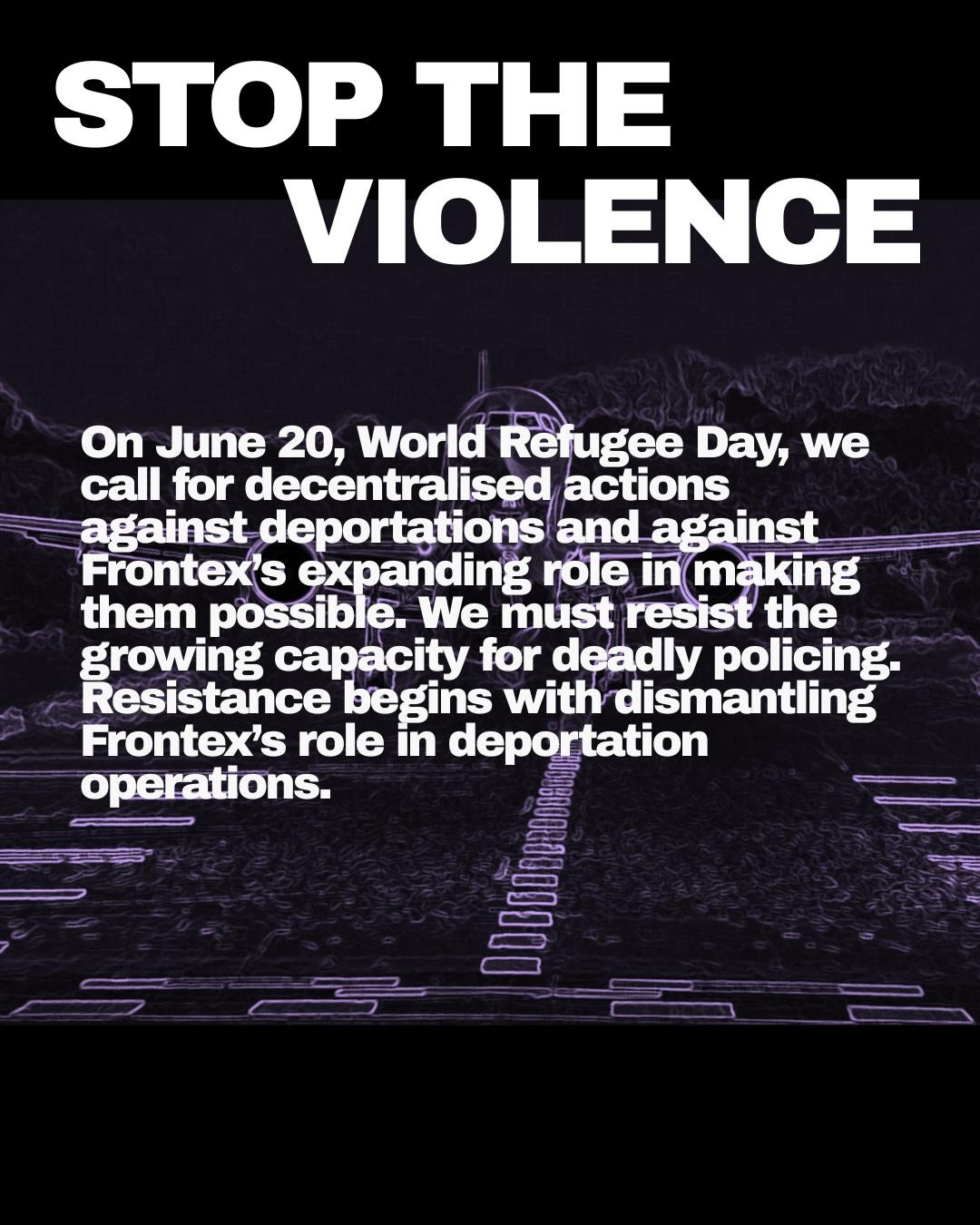
On June 20, World Refugee Day, we call for decentralised actions against deportations and against Frontex’s expanding role in making them possible. We must resist the growing capacity for deadly policing. Resistance begins with dismantling Frontex’s role in deportation operations.
From Europe and Africa, we raise a clear message: we will not stand by while deportations are expanded, normalised, and enforced through violence against people on the move.
There are many ways to take action: flyers, banners, graffiti, street posters, gatherings, speeches, art installations, demonstrations, occupations, blockades, sabotage, and more. Be creative, act together, and make the resistance visible.
Find more information about the movement, action ideas, and more here.
As always, please inform us if you are planning something in your city by emailing info[at]abolishfrontex.org so that we can integrate it into our communications.
The push to give Frontex more powers: Who’s behind it and why
Border Labs How Universities Power Europe’s Border Regime
25 March 2026 – In recent years universities all over Europe have faced criticism and protest actions in response to their ties to the fossil fuel industry and to Israel’s genocidal war machine. These protests have highlighted the extent to which universities are deeply entrenched in violent and repressive systems, providing research, data and advise to keep them running, refine and expand them. The need to secure external funding is often one of the drivers to participate in such work in the first place, especially in times where many governments impose significant cuts to higher education and research budgets.
The new report ‘Border Labs How Universities Power Europe’s Border Regime’ by the Transnational Institute (TNI) and Stop Wapenhandel shows that universities are similarly deeply involved in Europe’s repressive border and migration policies in multiple ways. They receive research and innovation funding from the EU’s Framework Programmes and a range of other EU instruments; strengthen their ties with border authorities, including Frontex, and with the military and security industry; contribute to the EU’s border externalisation efforts; and sometimes seek to commercialise academic work through the market.
Many people within universities produce fundamental and critical research that could pave the way for political change away from the EU’s untenable, violent and escalating border and migration policies. Students and faculty therefore have an important role in pushing universities to take action against their involvement in the border-industrial-academic complex that continuously expands and raises the walls of Fortress Europe.
From cooperation to complicity: meet the companies powering the EU’s war on migrants
11 March 2026 – Even as people continue to die at Europe’s borders, little is known about the private sector’s role in implementing increasingly draconian EU migration policies. In fact, when it comes to migration, the cosy relationship between private companies and EU institutions is purposefully kept far from public view, escaping scrutiny and transparency. As our new research shows, the truth is that such companies are getting more than their fair share of face time with EU policymakers, via pitch events that create exclusive opportunities to influence public spending and policymaking on migration topics.
Read the whole article by Caterina Rodelli on the website of Access Now.
Minneapolis: ICE and Frontex: When Border Violence Becomes Visible [En/It]
[italiano sotto]
On January 7th 2026, in Minneapolis, USA, an American woman named Renee Nicole Good, has been killed by an ICE (Immigration and Customs Enforcement) agent. The images released since then show a scene that already contradicts the official narrative: she can be seen backing up after an agent attempted to remove her from the car, moving forward and trying to turn around before being shot. She wasn’t charging at him. She was just doing an observation of an ICE operation on her route. The political response was immediate. Donald Trump and his government invoked for the ICE agent, self-defense, defended him, and designated the victim as a “terrorist” and an “agitator.” On the streets, the reaction is just the opposite: massive protests, anger, refusal to see this violence absorbed once again by the discourse of security.
Continue reading “Minneapolis: ICE and Frontex: When Border Violence Becomes Visible [En/It]”
Hamoudi v Frontex: Ending the Immunity of Frontex in Claims from Pushback Survivors
By Emma Fregonese, European and International Law student
On December 18, the Court of Justice of the EU delivered its judgment on the appeal brought by Alaa Hamoudi, challenging the violent and sometimes deadly pushback practices prevalent in the joint operations of the Hellenic Coast Guard and Frontex in the Aegean Sea. The judgment provides a historical shift in the application of the burden of proof, ending the de facto immunity of Frontex and recognising the duty of the General Court to carry out further investigations whenever necessary to guarantee the protection of individuals’ rights.
Actions in six EU countries against Frontex’s training infrastructure on International Migrants Day (18 December)
17 December 2025 – On December 18th, International Migrants Day, people in six EU countries will take action against the growing training infrastructure of EU border guard agency Frontex. This comes in response to an International Action Day called for by the Abolish Frontex network, consisting of more than 130 groups and organisations. The actions that are planned in Belgium, France, Germany, Italy, The Netherlands and Poland include demonstrations, public presentations and workshops.
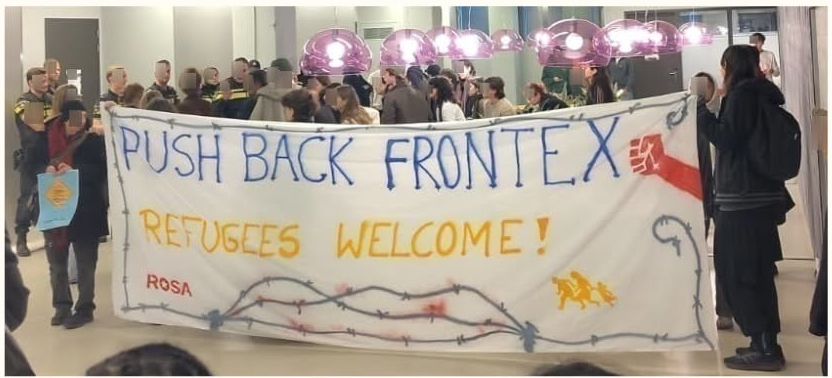
With the expansion of Frontex’s mandate, budget and organisation, especially since 2015, the agency’s training infrastructure has also gradually grown. Now Frontex has announced its first dedicated Training Center in Warsaw, set to open in October 2026. This center will be an exclusive factory for border police, intending to train over 200 officers per year and aims to rapidly expand its reach to other EU member states.
This new center, alongside its existing “Partnership Academies“ are militarized training grounds in order to standardize and normalize inhumane detention, deportation, and denial of safety to millions of people on the move. This is not about security; it’s about increasing the capacity for cruelty.
Kim, Abolish Frontex spokesperson, says: “Frontex training centers are normalizing exclusion and control. We will not stand by as Frontex recruits and trains border guards to inflict violence against people on the move! Money invested in Frontex infrastructure means more pushbacks, more deaths at sea and more suffering at EU borders.”
The Abolish Frontex network was launched in June 2021 to connect and strengthen protests against the EU’s deadly border regime. Over 130 organisations and groups in EU countries and beyond have joined the informal network that strives for freedom of movement for everyone.